
Journal of Management & Systems (TSSCI)
Manuscript Review Guidelines and Procedures
Revised and approved at the Second Executive Editorial Meeting of 2026 (2026.3.21).
This guide assists contributors in understanding the review logic and standards of Journal of Management & Systems. Our journal adheres to principles of academic rigor and fairness throughout the evaluation process. All submitted manuscripts must successfully undergo the following five-stage assessment.
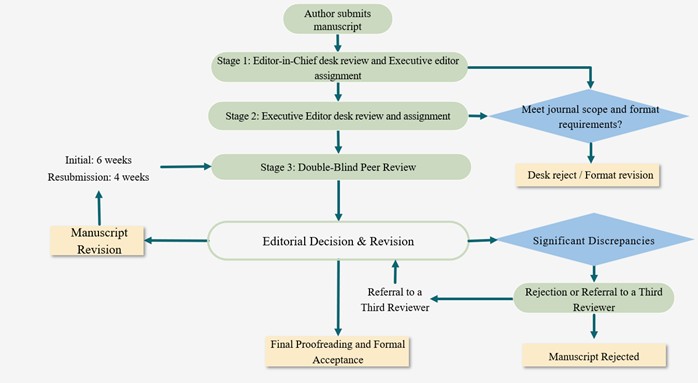
Stages I & II: Initial Screening by Editor-in-Chief and Executive Editor (or Guest Editor of Special Issue)
Upon submission, the Editor-in-Chief assigns an Executive Editor to conduct the first round of screening. This phase determines whether the manuscript qualifies for substantial external review. The Executive Editor evaluates the submission based on three primary criteria.
First, the research topic must align with the journal’s scope, including strategic management, human resources, or finance. Second, the editor assesses the manuscript for significant flaws in research design or logical framework. Third, the submission must strictly follow formatting rules, particularly regarding citations and “English translations for Chinese references.”
The screening results lead to two possible outcomes for the authors. If the work lacks academic merit or contains major flaws, it is rejected immediately. If the manuscript only requires formatting adjustments, the editor will request a revision within a specified timeframe. Failure to meet formatting standards after revision will also result in a desk rejection.
Stage III: Double-Blind Peer Review
Manuscripts that pass the initial screening are sent to the Editorial Board for further evaluation. The board invites two independent peer experts in the relevant field to conduct a double-blind review. These reviewers evaluate the academic value, originality, methodological rigor, and practical contribution of the work.
Reviewers provide one of four specific recommendations for the manuscript. They may suggest “Accept” if the work meets all publication standards without further changes. A “Minor Revision” indicates the paper is acceptable pending specific, small-scale corrections. “Major Revision” (Revise and Resubmit) is suggested for promising work that requires substantial theoretical or empirical improvements. Finally, a recommendation of “Reject” is given to manuscripts with terminal flaws.
Stage IV: Editorial Decision and Revision
The Executive Editor consolidates the peer review comments and submits a final recommendation to the Editorial Board. There are four potential outcomes at this decisive stage of the process. The board may officially “Accept” the manuscript if the revisions are thorough and satisfactory. Alternatively, it may issue a “Revise and Resubmit” request for further substantive improvements.
If significant discrepancies exist between the two reviewers, the editor may refer the manuscript to a third reviewer for arbitration. If the feedback is overwhelmingly negative or revisions fail to meet standards, the paper is rejected. Authors must adhere to strict deadlines for submitting their revised manuscripts. The deadline for the initial revision is six weeks, while subsequent re-review revisions are limited to four weeks. Authors requiring an extension must submit a formal request with valid reasons for board approval.
Stage V: Acceptance and Publication Preparation
Once a manuscript is formally accepted, it enters the administrative and typesetting phase of production. Authors must submit the final version of their manuscript in Word format at this time. Additionally, the corresponding author must provide a signed original copy of the “Copyright Transfer Agreement.”
Publication fees are calculated based on the final typeset version of the article. Authors are required to pay NT$300 per page before the manuscript is scheduled for publication. Regarding authorship rights, the copyright is jointly held by the Chinese Association of Business Administration and National Yang Ming Chiao Tung University. Furthermore, each author will receive one complimentary copy of the journal issue upon publication.
Additional Important Considerations
The journal aims to optimize review efficiency and typically provides the first-round decision within three months. However, timelines may be extended due to the reviewer recruitment process or complex evaluation cycles. We appreciate your patience should any unforeseen delays occur during the professional assessment of your work. If no notification is received after three months, authors are encouraged to contact the Executive Editor to inquire about the status.
Strict regulations apply to any changes regarding authorship to maintain academic integrity and protect all contributors. If authors wish to change the order or number of contributors during the revision stage, they must submit a written request. This request must include a detailed justification and a consent form signed by all original authors. Please note that no changes to authorship information are permitted once the manuscript has reached “Conditional Acceptance.” Contributors must ensure their work has not been published elsewhere and strictly follow the ethical guidelines of the journal.
This website is sponsored by
Research Institute for the Humanities and Social Sciences, National Science and Technology Council.