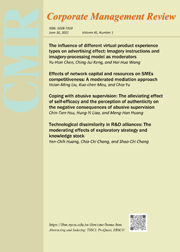
 Frequency : Semiannually
Month of Distribution : June / December

Contact Us:
Email:
nctucdmr1981@gmail.com
Phone:
+886-2-2349-4930
Special Issue Call for Papers
Building a Positive Workplace and Fostering Sustainable Talent Development
Guest Editors:
Kuo-Yang Kao, PhD
Department of Management Science, National Yang Ming Chiao Tung University
Wan-Jing April Chang, PhD
Department of Educational Psychology and Counseling, National Tsing Hua University
Chun-Hsiao Wang, PhD
Graduate Institute of Human Resource Management, National Central University
In the face of multiple challenges posed by globalization, digital transformation, and the post-pandemic era, organizations must actively embrace social responsibility and sustainable development while pursuing organizational effectiveness. In this era of rapid change, uncertainty, complexity, and ambiguity, employees have become the most critical asset for organizations. The health, well-being, and retention of employees not only directly influence a company's long-term competitiveness but also form the core of its sustainable development.
The essence of building a positive workplace and fostering sustainable talent development lies in actively developing a healthy organizational system, including procedures, polices, and practices that promote the comprehensive well-being of employees. The implementation of this concept hinges first upon effective leadership and a positive organizational culture or climate. Leaders must leverage consideration and supportive behaviors to establish a climate of safety and psychosocial safety while actively curbing workplace negative behaviors to fundamentally safeguard employee mental health.
Furthermore, a positive workplace is realized through thoughtful institutional design. This encompasses providing flexible policies that support the work-life interface, ensuring work schedules that allow for adequate rest and recovery, and implementing innovative stress and wellness management programs. It must also be attentive to the diversity and life cycle of the workforce, for example, by offering age-friendly job designs for an aging workforce to promote their cognitive health and continued contributions.
Ultimately, through systematic intervention strategies such as Employee Assistance Programs (EAPs) and the application of Positive Psychology, organizations can translate their commitment to employee care into sustainable human capital. A successful positive workplace achieves a win-win for both employee well-being and organizational performance, allowing talent to develop over the long term in a healthy environment and thereby building a solid foundation for the firm's sustainable competitive advantage.
This special issue aims to foster a profound dialogue between research and practice on the topics of building a positive workplace and fostering sustainable talent. We cordially invite researchers from relevant fields to submit their work. We welcome scholarly submissions that are theoretically grounded, methodologically rigorous, and offer practical insights and forward-thinking policy recommendations. Together, we can explore innovative management paradigms, organizational structures, and policy practices to create a healthy work environment that both enhances employee well-being and achieves organizational sustainability in the face of current and future challenges.
Topics of Interest
Submissions on topics including, but not limited to, the following are welcome:
The Work-Family/Life Interface
˙Reviews of the theoretical evolution, integration, and practical implications of work-family/life interface research.
˙The effects of work-life balance, work-family enrichment, and family-friendly policies on employee well-being and organizational performance.
˙The dual role of remote work and digital technologies in facilitating or hindering the work-life interface.
Workplace Negative Behaviors and Unfriendly Environments
˙The antecedents, consequences, and mechanisms of workplace violence, discrimination, incivility, and sexual harassment, along with prevention and intervention strategies.
˙The role of leadership, organizational culture, and institutional policies in curbing negative workplace behaviors.
˙The long-term impact of unfriendly environments on employee mental health, job performance, and turnover, with a special focus on marginalized or diverse employee groups.
Cognitive Functioning, Aging, and Work
˙Work adaptation, occupational health, and job performance of an aging workforce in the context of changing cognitive functions.
˙How age-friendly job design, training mechanisms, and technological innovations can support the cognitive health and productivity of employees across different age groups.
˙The influence of intergenerational diversity on team dynamics, knowledge transfer, and organizational innovation.
Safety Climate and Culture
˙Effective methods for measuring, establishing, and maintaining a positive physiological and psychological safety climate and culture.
˙The influence of leadership styles, employee participation, and organizational commitment on safety performance.
˙How psychological safety promotes employee voice, team learning, and organizational resilience.
Employee Recovery and Rest
˙The types, mechanisms, and effects of employee recovery experiences (both within and outside of work) on physical/mental health and work engagement.
˙Organizational policies, such as work-hour and leave designs, that support effective employee rest and recovery.
˙A multi-level analysis (individual, team, organizational) of the burnout phenomenon and its relationship with the sustainability of human capital.
Leadership and Employee Psychological Well-Being
˙The impact of different leadership styles (e.g., Transformational, Servant, Ethical, Authentic, Sustainable) on employee psychological well-being, stress, and job satisfaction.
˙How leaders can build high-quality interpersonal relationships and a healthy workplace atmosphere through emotional intelligence, empathy, and supportive behaviors.
Leaders' Mental Health at Work
˙Empirical, methodological, and policy-oriented research on the mental health challenges, stressors, and coping resources unique to leaders.
˙Organizational support systems for leaders, including psychological support, coaching, and systemic interventions.
˙The ripple effect of leaders' mental health on their decision-making quality, team management, and organizational culture.
Managing Employee Stress and Wellness
˙The effectiveness evaluation and implementation challenges of innovative employee wellness programs and stress management techniques (e.g., mindfulness, digital health tools).
˙The study of integrative employee well-being, encompassing physiological, psychological, social, and financial health.
˙The strategic adaptation and resilience of corporate wellness strategies in response to major crises, such as global pandemics.
Intervention Strategies for Enhancing a Positive Workplace
˙The evaluation of evidence-based interventions aimed at fostering positive emotions, work engagement, and organizational citizenship behaviors.
˙The application of Positive Psychology in organizations, such as the development of Psychological Capital.
˙How effective Employee Assistance Programs (EAPs), job redesign, empowerment, and performance feedback systems can systematically build a supportive and high-performance work environment.
Digital Technology, Artificial Intelligence, and Employee Well-being
˙The opportunities and challenges brought by digital technology and artificial intelligence in shaping positive workplace experiences.
˙The procedures, policies, and practices that leverage digital technology and AI-driven interventions to enhance employee mental health and well-being.
˙The employee mental health and well-being in human-AI collaboration contexts across different organizational cultures, leadership styles, and job characteristics.
Sumission Guidelines and Deadlines
The deadline for submissions to this Special Issue is August 31, 2027. Submissions should adhere to the formatting and standard requirements of the Corporate Management Review. Authors should ensure they adhere to the journal author guidelines which are available at https://ibm.nycu.edu.tw/ibm/cmr/Submission.htm. Submissions are to be sent via email to nctucdmr1981@gmail.com. The submission fee is in accordance with the Corporate Management Review's standard rates. More information on the special issue or the workshop can be obtained from the guest editors:
Kuo-Yang Kao at kykao@nycu.edu.tw
Wan-Jing April Chang at wjchang@mx.nthu.edu.tw
Chun-Hsiao Wang at wangch@cc.ncu.edu.tw